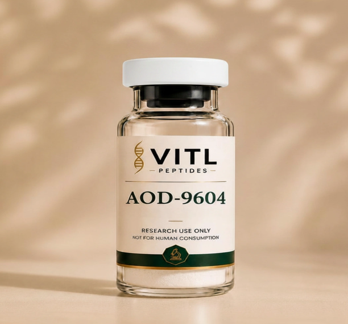
ByJohn A
AOD-9604 Peptide: Mechanism, Scientific Evidence, and Research Quality
AOD-9604 is a synthetic peptide fragment derived from a region of human growth hormone that has attracted scientific interest because of its proposed effects on fat metabolism. Researchers have investigated its biological activity, potential metabolic applications, and safety profile, but findings must be interpreted carefully. Laboratory observations and early clinical research do not automatically establish effectiveness or safety for routine human use.
When reviewing an AOD-9604 peptide, it is important to distinguish the compound’s chemical identity from claims about its effects. Reliable research requires transparent product specifications, appropriate analytical testing, credible scientific literature, and a clear understanding of regulatory restrictions.
What Is AOD-9604 Peptide?
AOD-9604 is a modified peptide fragment associated with human growth hormone research. It was investigated in part because scientists wanted to examine whether selected biological activities related to fat metabolism could be studied separately from the broader effects of full-length growth hormone.
Understanding its structure and research history helps clarify both its scientific interest and the limits of claims made about it.
Understanding Its Relationship to a Fragment of Human Growth Hormone
Human growth hormone is a protein produced by the pituitary gland. It participates in growth, tissue maintenance, and metabolic regulation through several biological pathways. AOD-9604 was developed from a small region near the C-terminal end of the growth hormone molecule, with modifications intended to influence its biological properties.
The compound is not the same as full-length human growth hormone. Researchers have investigated whether a selected fragment could demonstrate activity associated with lipid metabolism without reproducing all the actions of the complete hormone. However, a fragment’s activity cannot be assumed from the functions of the original protein. Its effects must be evaluated through direct experimental evidence.
Basic Structural Characteristics of AOD-9604
AOD-9604 is a short, modified peptide rather than a complete protein. Its amino acid sequence and chemical modifications are central to its identity, stability, and interaction with biological systems. Small structural differences can influence a peptide’s behavior, making accurate identification important in laboratory research.
Researchers and laboratories should therefore confirm the compound’s stated sequence, expected molecular mass, purity specifications, and batch identity. A product name alone is not sufficient evidence that a sample contains the intended substance.
Why Researchers Have Investigated This Peptide
Interest in AOD-9604 has largely focused on proposed effects involving fat breakdown and fat metabolism. Early research explored whether the fragment could influence lipid-related processes while having a different profile from full-length growth hormone.
These research questions do not establish that AOD-9604 produces clinically meaningful weight loss or offers a proven treatment for metabolic conditions. Its scientific significance depends on the quality, reproducibility, and relevance of the available evidence.
How Is AOD-9604 Studied in Scientific Research?
Research on a peptide requires a defined experimental question, suitable controls, and methods that can measure the intended biological response. Findings should also be considered in the context of the model used, since activity in a controlled laboratory system may not predict what happens in a human body.
Proposed Biological Mechanisms
AOD-9604 has been investigated for possible effects on lipolysis, the process through which stored fats are broken down. Researchers have also examined whether it influences other metabolic processes relevant to fat storage and energy regulation.
These proposed mechanisms should be treated as research questions rather than established clinical effects. Biological pathways are complex, and a measurable change in one process does not necessarily translate into a meaningful change in body composition or health. The mechanism, magnitude, and consistency of any reported effect require careful evaluation.
Laboratory and Animal Research Models
Laboratory studies can help researchers investigate interactions with cells, examine biochemical pathways, and assess responses under controlled conditions. Animal studies can provide additional information about biological activity, exposure, and selected safety outcomes that cannot be assessed in cell-based experiments alone.
However, each model has limitations. Cell studies do not reproduce the full complexity of an organism, while animal physiology may differ significantly from human physiology. Results may also depend on the experimental design, dose, duration, and measurement methods. Researchers should avoid treating findings from one model as proof of a predictable effect in another.
What Human Studies Can and Cannot Establish
Human studies can provide information about tolerability, pharmacological behavior, and potential outcomes under defined conditions. Their strength depends on factors such as sample size, study duration, comparison groups, participant characteristics, and the quality of outcome measurements.
Small or short studies may identify questions for further investigation, but they generally cannot establish long-term safety or effectiveness on their own. Human evidence must be evaluated alongside study limitations, independent replication, and the totality of available research.
What Does the Scientific Evidence Say About AOD-9604?
The evidence surrounding AOD-9604 should be assessed by separating experimental findings from conclusions that have been demonstrated in people. This distinction is especially important when a compound is discussed in connection with weight management or other health outcomes.
Reviewing Preclinical Findings
Preclinical studies have explored AOD-9604 in relation to fat metabolism and related biological processes. Such studies can help identify potential mechanisms and determine whether further investigation is justified. They can also reveal inconsistencies that require additional testing.
Nevertheless, preclinical findings do not demonstrate that a compound will deliver a specific outcome in humans. Differences in metabolism, exposure, biological response, and experimental conditions can affect whether early results are reproducible. Strong conclusions require a coherent body of evidence rather than reliance on a single favorable result.
Understanding the Results of Human Research
Human research is necessary to determine whether observed biological activity translates into meaningful outcomes. Studies should be assessed for their design, endpoints, statistical strength, duration, and relevance to the claims being considered.
A result involving a particular measurement does not necessarily prove an overall clinical benefit. Researchers should also look for independent replication and transparent reporting of unfavorable or inconclusive findings. Without adequate evidence, claims about reliable weight reduction, long-term benefits, or broad metabolic effects remain unconfirmed.
Why Experimental Findings Do Not Guarantee Clinical Effectiveness
A compound can show activity in a laboratory without becoming an effective medicine. Clinical effectiveness depends on whether the intended effect occurs reliably in people, whether the magnitude is meaningful, and whether the benefits outweigh potential risks.
Translation from research to clinical use typically requires a sequence of studies, including appropriate safety assessments and controlled clinical trials. AOD-9604 should therefore be discussed in terms of the evidence available, not as a proven solution based solely on its proposed mechanism or early research history.
What Are the Safety and Regulatory Considerations for AOD-9604?
Safety assessment involves more than identifying a compound’s intended biological activity. Researchers must consider the quality of the material, possible contaminants, exposure conditions, and the limitations of available toxicological and clinical information.
Gaps in Available Safety Information
The amount of published information on a compound may be insufficient to establish its safety across different populations, exposure periods, or routes of administration. Short-term observations cannot reliably rule out uncommon adverse effects or risks associated with longer exposure.
The absence of a reported problem is not proof that a compound is safe. Research conclusions should clearly describe what has been studied, what remains uncertain, and which outcomes have not been adequately evaluated.
Potential Concerns About Peptide-Related Impurities and Immunogenicity
Peptide products may contain synthesis-related impurities, degradation products, residual solvents, or other contaminants if manufacturing and purification controls are inadequate. These substances can complicate experimental results and create safety concerns.
Peptides may also raise immunogenicity questions, meaning they could potentially trigger immune responses. The likelihood and significance of such responses depend on factors including molecular characteristics, impurities, exposure, and the biological context. Researchers should not assume that a peptide is free from these concerns simply because its sequence is known.
Understanding Regulatory Status and Restrictions on Human Use
A product being listed for research does not mean it is approved as a medicine. Regulatory status varies by jurisdiction and intended use, and restrictions may apply to manufacturing, distribution, possession, or human administration.
Researchers should consult the relevant national regulator and institutional requirements before conducting work involving a research compound. Product availability, online descriptions, and seller statements are not substitutes for formal authorization or clinical evidence.
How Can Researchers Evaluate AOD-9604 Product Quality?
Reliable experimental work depends on knowing what a sample contains and whether its characteristics match the stated specifications. Product documentation should be specific to the material supplied and sufficiently detailed to support independent assessment.
Verifying Peptide Identity and Batch Specifications
Review the stated peptide sequence, expected molecular mass, batch or lot number, purity specification, and available analytical results. Confirm that the documentation identifies the same product and batch being evaluated.
A credible supplier should present consistent product information and explain the scope of its testing. Vague descriptions, missing batch details, or unsupported claims of exceptional quality make it difficult to assess whether a sample is suitable for research.
Reviewing HPLC and Mass Spectrometry Documentation
High-performance liquid chromatography (HPLC) is commonly used to assess the chromatographic purity of a sample by separating its components. The resulting profile can help identify the main peak and indicate the presence of additional detectable components.
Mass spectrometry can help assess molecular mass and support identity verification. Used together, these techniques provide complementary information, but neither guarantees that a product is suitable for every experiment. Researchers should review the actual analytical report, methods, acceptance criteria, sample identification, and any stated limitations rather than relying only on a percentage displayed on a product page.
Assessing Storage, Stability, and Packaging Information
Peptide stability may be affected by temperature, moisture, light, handling, and time. Appropriate storage conditions depend on the specific formulation and supporting stability information. Researchers should follow documented handling guidance and established laboratory procedures.
Packaging should protect the material from contamination and environmental exposure during transit and storage. Batch identification and traceability should remain clear throughout the research process. If stability data or handling instructions are unavailable, that uncertainty should be documented rather than replaced with assumptions.
How Should Researchers Assess Claims About AOD-9604?
Scientific claims should be proportionate to the strength of the evidence supporting them. A careful review considers not only whether a result was reported, but also how it was measured, whether it was replicated, and whether the conclusions follow from the data.
Separating Marketing Language From Published Evidence
Terms such as “proven,” “guaranteed,” or “clinically effective” require strong supporting evidence. Promotional descriptions may simplify complex findings or present proposed mechanisms as established outcomes. Researchers should verify important statements against peer-reviewed publications, trial records, and relevant regulatory information.
For general company information and product context, readers can consult Vitl Peptides, while treating supplier descriptions as product information rather than independent scientific confirmation.
Evaluating Study Design and Research Limitations
When reading a study, examine the research question, methods, sample size, control conditions, outcome measures, statistical analysis, and declared conflicts of interest. Consider whether the results were replicated and whether the authors acknowledged important limitations.
A study’s conclusion should not be broader than its design permits. Research conducted in cells, animals, or a small group of participants may support further investigation, but it cannot establish every claim made about a compound.
Why Medical Decisions Require Appropriate Clinical Evidence
Research compounds should not be treated as substitutes for approved treatments or professional medical guidance. Decisions about diagnosis, weight management, or treatment require evidence relevant to human health, including appropriate clinical studies and an assessment of risks and benefits.
For additional background about the company, visit the About us page. Company information can explain a supplier’s stated approach, but it does not replace independent evaluation of scientific claims, product documentation, or regulatory status.
Frequently Asked Questions
What Is AOD-9604?
AOD-9604 is a synthetic, modified peptide fragment derived from a region of human growth hormone. It has been investigated mainly for possible effects on fat metabolism. Its proposed biological activity should not be interpreted as proof of clinical effectiveness.
How Is AOD-9604 Different From Full-Length Growth Hormone?
AOD-9604 is a short fragment with specific modifications, whereas full-length human growth hormone is a complete protein involved in several physiological processes. The two are not interchangeable, and the fragment should not be assumed to reproduce the complete hormone’s effects.
What Types of Studies Have Examined AOD-9604?
Research has included preclinical investigations, such as laboratory and animal studies, as well as human research. Each type of study answers different questions. The strength of any conclusion depends on study quality, reproducibility, and relevance to the outcome being assessed.
Is AOD-9604 an FDA-Approved Medicine?
AOD-9604 should not be assumed to be an FDA-approved medicine. Researchers and readers should verify current status through official FDA resources and relevant regulatory authorities. Availability from a research supplier does not establish approval for human use.
What Should Researchers Look for in an AOD-9604 Certificate of Analysis?
A certificate of analysis should identify the product and batch, report relevant analytical results, and describe the methods used where applicable. HPLC may provide information about chromatographic purity, while mass spectrometry can support identity verification. Researchers should also review report traceability, test limitations, and whether the document corresponds to the batch received.
Conclusion
AOD-9604 remains a subject of scientific interest because of research into its relationship with fat metabolism. However, its proposed mechanisms and early findings should be distinguished from evidence establishing clinical effectiveness and long-term safety. Preclinical results, human research, and regulatory information each contribute different pieces of the overall assessment.
For responsible research, evaluate product identity, batch-specific documentation, analytical testing, storage guidance, and the credibility of claims. HPLC and mass spectrometry reports can support quality assessment, but they should be interpreted within their stated limitations. Ultimately, conclusions about AOD-9604 should reflect the available evidence, and research availability should never be confused with authorization or proof of suitability for human use.